Visual Snow: That makes me see like a TV from 60s!
Mainstream medicine once attributed visual snow to hallucinogen users, then quietly labelled it rare. But my own experience — talking to sufferers, reading the research, and living with the condition — suggests it is anything but rare.
2/25/202612 min read
Visual Snow Syndrome (VSS)
Imagine trying to describe a visual symptom that has no name, leaves no trace on any scan, and sounds made up even as you're saying it out loud. Now imagine doing that to a doctor who has seventeen other patients waiting. This is the daily reality of Visual Snow Syndrome — the condition where you see static in your vision (some call it grainy vision) that is common enough to affect thousands (perhaps millions?), obscure enough that most sufferers have never heard of it, and just weird enough that the first medical explanation was "probably drugs."
Some people are born with it and never know any different. Others discover it one day and can't unsee it — which, if you're reading this, might sound familiar. The grains are generally not at a level to block the vision, and in most cases, they are quite subtle. The best visual I have found how I see is the following, but mine is not that severe, slightly less subtle:
And no, they are not floaters. Floaters are common visual phenomena like this one
Visual Snow is always there and its not floating. It is static. When I close my eyes, I see like below, although not that white. It is harder to explain but something like white, off white and light red/pink. From that point, it is similar to closed eye hallucinations (CEH).
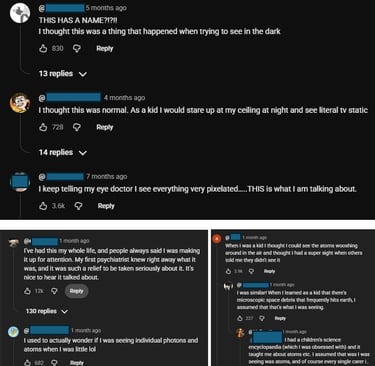
Funny thing is, many people live with this condition and never question whether it's normal. For them, this is just how everybody sees. Others genuinely believed they could see atoms! Don't believe me? Look at these comments:
Visual snow made its debut in medical literature around 1995, when doctors initially assumed it was caused by hallucinogenic drugs. Plot twist: plenty of people who have never touched anything stronger than a gas station energy drink have it too. So that theory went out the window, leaving everyone slightly more confused than before.
Here is what is known about this syndrome:
No brain or eye anomaly is detected. You're neurologically pristine. Congratulations!
Afterimages and trailing of moving objects (called palinopsia) tag along for the ride.
Enhanced floaters, spontaneous light flashes, and other fun bonus visual features
Light sensitivity, because why not? I sneeze in the sun, while many people do not understand why. I thought it was a common thing!!!
Poor night vision: you still see static in a dark room, which is great if you enjoy the aesthetic of a horror movie but less great for, say, sleeping.
Some visual snowers also get to enjoy migraines, tremors, balance problems (I too had them), and general brain fog.
Research published by the Visual Snow Initiative (one of the few organizations actually taking this seriously) suggests that around 70% of people with visual snow experience at least one of these additional symptoms. So, if you came here just for the static and left with a whole bonus package, welcome to the club. We have terrible lighting.
The leading medical explanation is increased neuronal excitability — essentially, your visual cortex is hypersensitive and starts picking up signals it was supposed to filter out. Think of it like a microphone turned up too high; it stops amplifying sound and starts amplifying everything, including all the noise that was never meant to be heard. Most people's brains quietly suppress this visual noise. Ours, for reasons still not fully understood, do not.
I personally notice it most on white backgrounds. Working in Word or Excel becomes a special kind of torture after a while. Fluorescent office lighting makes it worse, which means the modern open-plan office was apparently designed with visual snow sufferers specifically in mind. But this might be because I am exposed to fluorescent light more in offices where I work with word and excel, hence a perfect storm.
What's interesting — and this is where it gets less textbook and more human — is what I started noticing when I connected with other people who have this condition. After writing about it online, I heard from dozens of them. And the patterns were hard to ignore, even if my sample size is, scientifically speaking, "a bunch of strangers who found my post." Take this with the appropriate grain of visual snow.
Almost everyone had some form of anxiety. Not just "I worry sometimes" anxiety, but the kind that sends you down medical rabbit holes at midnight, convinced you have seventeen overlapping conditions. Which, to be fair, is a completely rational response to seeing static constantly and being told by three different specialists that nothing is wrong with you. Combine it with other visual/auditory symptoms, and you may easily convince yourself that you have a brain tumour, the scariest medical symptom every hypochondriac is afraid of!
The anxiety connection is the one I keep coming back to. Almost everyone I spoke to had it — not mild background worry, but a fee notches more kind. And here's the question nobody seems to want to sit with: if there is a relation between the tow, which one came first? Did the anxiety sensitise the nervous system and turn up the visual noise? Or did waking up one day to find the world had gone grainy — and then being told repeatedly by doctors that nothing was wrong — produce the anxiety? Because both are plausible. Both are, frankly, completely reasonable responses to the situation. Chronic stress raises cortisol, which raises neurological sensitivity, which could theoretically lower the threshold at which your brain starts reporting static. But equally, seeing something that nobody else can see, that leaves no trace on any scan, and that sounds unconvincing even as you describe it — that would give anyone anxiety. I genuinely don't know which direction the arrow points. I'm not sure the research does either. What I do know is that in almost every person I spoke to, the two arrived together, and untangling them felt impossible. Maybe that's the point. Maybe they're not two separate problems at all.
Then there was the physical pattern that I genuinely did not expect. Nearly everyone I spoke to had neck problems. Specifically, a loss of the natural cervical curve, sometimes called flat neck or military neck. And almost in the same breath, they'd mention jaw issues. TMJ dysfunction, teeth grinding, chronic jaw tension. At first I noted it as an interesting coincidence. Then I noted it again. And again. After the twentieth or thirtieth time, I stopped calling it a coincidence and started keeping a mental tally. I'm not a neurologist, and I want to be careful not to overstate what is essentially a pattern spotted by a stranger on the internet. But the consistency was striking enough that I couldn't in good conscience mention VSS without mentioning this. I'll go into the proposed mechanisms properly later — there are a few, and some of them are more grounded than you'd expect — but for now I'll just say: if you have VSS and you also have a stiff neck and a clenched jaw, you are not the only one, and it may not be a coincidence.
As I mentioned before, most of the people suffer from this condition, and the ones are aware that it is not normal to pay visits to doctors. They initially go to eye clinics, but the doctors cannot find anything wrong with the eye and retina. Then they are referred to neurologists, which also cannot find anything. Some take further scans like head MRI, which all comes out negative. I met many people who are finally referred to as a mental health provider, hoping that some antidepressants may provide relief.
If you have this conditions, please know that:
You probably aren't broken. I have a theory I call the Nose Notice Threshold®. When both your eyes are open, you don't see your nose even though it's literally right there. But when you close one, you can see your nose! Wild, isn’t it? What happens is that, through evolution, your brain learned to edit it out. Most people's brains quietly file away the visual static the same way or fill in the gap, so no grey dots are reported. Some of us just... didn't get that memo. Our brain filter is set to report everything they see, including static.
You're not alone — many people just assume everyone sees it this way and never question it. Ignorance is, genuinely bliss.
You don't have mental problems. You have a quirky visual system. There's a difference.
While I am at it, I will explain what the current research says about potential causes of visual snow, and of course my theories about what may be the issue here.
So what does the medical community actually think is going on? I will list their theories in a boring fashion, in line with medical research language:
Cortical Hyperexcitability: The visual areas of the brain, particularly the right lingual gyrus, appear to be overactive. Nobody knows why, but the short version is: you might simply be seeing more than everyone else. Sounds like a superpower until you're staring at a white page under fluorescent lights at 9am.
Reduced Sensory Thresholds: The brain's filter gets set too low and starts flagging signals that should be ignored. This is essentially what my Nose Detection Threshold® theory says, just with more syllables.
Thalamo-cortical Dysrhythmia: Disrupted communication between the thalamus (the brain's sensory relay station) and the cortex, leading to faulty signal processing.
Serotonin and Glutamate Dysregulation: Imaging research suggests neurotransmitter imbalances may explain the hyperactive neural state.
All plausible. None of them conclusive. Welcome to Visual Snow research, where every answer comes with three new questions.
While these are all plausible explanations the triggers are yet unknown. They propose stuff like head trauma, past illnesses and hallucinogenic drug use (which I never used, or perhaps I used so much that I don’t remember! 😊), I don’t think that they are effective in explaining the situation.
There are other theories around the web, which I gathered here. Perhaps fellow visual snowers can elaborate if this fits their situations.
Flat Neck
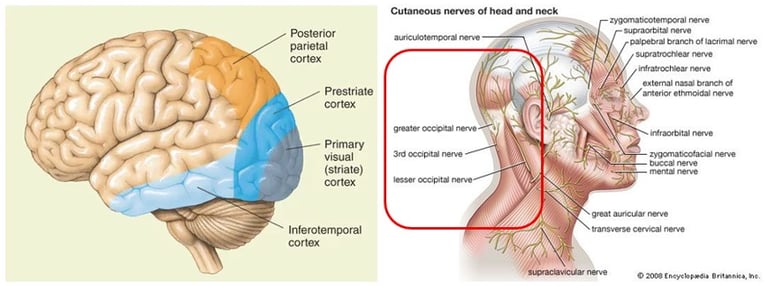
As I said before, almost all people I know with VSS have neck problems, particularly neck curvature loss. This has been proposed in several forums and medical sites that neck problems might be contributing to, or triggering the VSS. How might it be? There are a few proposed mechanisms. There are several nerves that go to your visual cortex of, which is located at the very back of your head. (while considering eyes are at the very front, it is ironic, isn’t it?)
When you have flat neck, which means your head moves forward, these nerves become more stretched and apply pressure on the visual cortex. That might explain why majority of the people contacting me have been working on desk-related jobs.
Temporomandibular Joint (TMJ) Problems
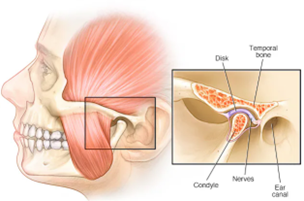
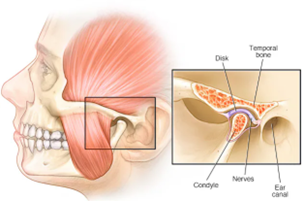
Temporomandibular joint connects your jawbone to your skull on both sides of your face. It acts as a hinge, enabling crucial functions like chewing, talking, and yawning.
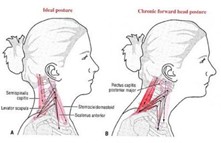
TMJ problems happen when people overuse this joint. You might imagine that it is not easy to overuse the joint by just eating or talking (not sure about that one though) but the main reason for the issues here is teeth clenching and night-time grinding. Surprisingly (!) this is also common with people who are under stress or have anxiety. I once read an article by a famous neurologist, who associated TMJ problems with flat neck. Her point was that when you clench your teeth or tighten your jaw muscles, they are deeply intertwined with your neck muscles (you can see it in the photo). When you over strengthen these muscles, they might be pulling the head to front, leading to flat neck. If you think about it, unlike animals that move on their four legs, who try to support their head using neck muscles at the back, we as evolved humans rarely use our neck muscles. Over strengthened front neck muscles might be causing an imbalance on the neck.
I also read an article by a British orthodontist who said that his patients with VSS reported reduction in their symptoms once they start using a night guard. And those who lost their night guards complained that VSS came back. This might suggest that relaxing the neck muscles might provide temporary relief.
I also read in the forums that some people who had a special muscle called Suboccipital release (which is a manual therapy technique targeting the small muscles at the base of the skull to relieve tension headaches, neck pain, and TMJ dysfunction) report temporary relief from VSS.
These all suggest that neck and TMJ, which are intertwined, might be playing a role in the VSS.
Computers
Look, the condition was recorded for the first time in 1995. That was the year when I got my first desktop PC. Is this a coincidence? Most likely! But hear me out: usage of computer might have exacerbated the VSS. This is of course my own theory but imagine, we were never exposed to something that we look from a very short distance, with many bright colours, continuously changing. Think of our ancestors from savannah, think of Roman soldiers fighting 100 AD. Or French revolutionists, farmer in Utah in 19th century. No one ever has seen such a thing or complained about such a syndrome in medical literature, and in 1995, bam! Suddenly we learned about this. If continuously changing multi-coloured bright lights do not “hyper excite” your visual cortex, I don’t know what else can. As an engineer I like finding connections between events. My main concern was, why wasn’t it identified much earlier. Even guinea worm infection was depicted in pictures as early as 14th century pictures, Come on!
It might also be a reason why people notice it first during intense stress time, as some people report work related stress. Work related stress might be coinciding with extra computer usage (i.e, finishing a report or preparing a presentation)
Fluorescent Lights
Fluorescent lighting is, to put it diplomatically, not great for anyone. It flickers at high frequency (usually imperceptible, but your visual system notices) and over time it contributes to eye strain, headaches, and increased light sensitivity. For someone whose visual cortex is already running too hot, it's a bit like turning up the brightness on a screen that's already at maximum.
It's also worth noting that widespread fluorescent office lighting is a relatively recent invention. Most people didn't spend eight hours a day under it until the latter half of the 20th century. Whether it causes VSS or simply aggravates it is unclear, but the timing is at least worth raising an eyebrow at, especially since many people first notice their symptoms during stressful work periods, which tend to mean more time in the office and less sleep. Lowered threshold, bad lighting, a looming deadline — and suddenly you're very aware of the static.
Other Potential Causes
A few other theories are floating around in medical and research circles, none of them conclusive, but worth mentioning.
Some researchers have proposed that increased intracranial pressure — pressure within the skull with no obvious cause — could be overstimulating the visual cortex. This is more grounded than it sounds; idiopathic intracranial hypertension is a documented condition, and there is evidence that cervical instability (flat neck, again!) can cause the nerves around the upper spine to become hyperactive, leading to increased pressure behind the eye and optic nerve irritation. The flat neck connection keeps showing up from so many different angles that it's getting harder to dismiss as coincidence.
The most intuitive theory in this group, to me at least, is optic nerve compression. When the optic nerve is under chronic low-level pressure, it can produce exactly the kind of visual static VSS sufferers describe. If you've ever slept on your arm at a bad angle and felt that tingling, buzzing numbness, the idea isn't too far off — just happening to your vision instead of your fingers.
And then there are the theories that are nearly impossible to verify: microscopic differences in neural tissue or blood vessel thickness potentially affecting blood flow to the eye or visual cortex. Maybe. Who knows. We're talking about microns here, well beyond what standard imaging can detect. Science will catch up eventually.
It's a Wrap!
So does any of this disturb me? Not really. Most days I don't notice it at all, which is itself proof of the Nose Detection Threshold® in action — the moment I stop hunting for the static, my brain quietly files it away.
If you've just discovered you have this, I know the temptation is to go deep, perhaps joining every forum, reading every thread, catalogue every new visual quirk. I did that too. But there's a strange irony in VSS: the more attention you give it, the more real estate it takes up. The less you do, the more your brain quietly learns to file it away. That's not toxic positivity — that's literally how the neuroscience works.
You are not broken. You are not going blind. You are not quietly losing your mind, despite what three separate 3am Google sessions may have suggested. You just see the world with a little extra grain. Some people have perfect pitch and can't unhear every out-of-tune note in a song. Some people have hypersensitive smell and suffer through every commute. You got the visual edition.
There are worse things to be than someone who sees a little more than everyone else.
I have yet to see a cucumber complaining about its green colour. Take the hint.
Have a great day!
P.S. Still hungry for more? The Visual Snow Initiative is the best place to start: https://www.visualsnowinitiative.org/learn/







Potentially a Guinea worm creeping out of the leg of St. Roch, who was a 14th-century French pilgrim. Maybe this super rare condition was a bigger issue then, since they had no idea about TV static! (Image credit: Raffaele Gaeta)

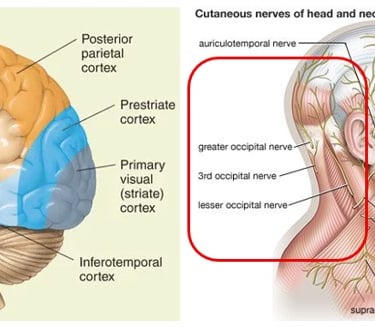
On left, you can see the visual cortex at the very back of the head. On the right I have highlighted the visual nerves coming from the neck.

Stay
Join the MyWeirdSymptoms community to stay in touch!
Subscribe to My newsletter
© 2025. All rights reserved.
Disclaimer
The content on My Weird Symptoms is for informational and entertainment purposes only. Nothing on this site is intended to be, or should be taken as, medical advice, diagnosis, or treatment. All opinions expressed here are the author's own and are based on personal experiences, research, and humour — not professional medical training.
Always seek the guidance of a qualified healthcare professional with any questions you may have regarding your health or a medical condition. Never disregard professional medical advice or delay seeking it because of something you've read here. If you think you may be experiencing a medical emergency, call your doctor or emergency services immediately.
Copyright & Fair Use
My Weird Symptoms occasionally uses images, graphics, or short clips from third-party media (such as TV shows, movies, and books) for purposes of commentary, criticism, humour, education, or parody. These materials remain the property of their respective copyright holders. We make no claim of ownership and do not intend to infringe on any copyrights.
Such use is intended to fall under fair use (17 U.S.C. § 107) as commentary, criticism, or parody. We use only small portions necessary to illustrate our commentary and always provide proper attribution where possible. If you are a copyright holder and believe any content should be removed, please contact us, and we will address it promptly.
Accuracy & Liability
While we strive for accuracy, information on this site may become outdated or contain errors. We make no guarantees about the completeness, reliability, or accuracy of information presented. Any action you take based on information from this site is strictly at your own risk.