What Is Anxiety? (and why it is good for you)
You're lying in bed. It's 2 AM. Your heart is doing something it definitely wasn't doing an hour ago. You have a presentation tomorrow, a weird pain in your left side, and a growing suspicion that you may be dying.
3/4/20266 min read


Here is something nobody tells you about anxiety: it's actually working. Not against you, not despite you, but exactly as intended. The racing heart, the catastrophic thoughts, the certainty that something is terribly wrong, all of it is your body doing its job with impressive efficiency. Unfortunately, it's doing a job that hasn't been strictly necessary for about 200,000 years.
Your Brain Is an Overprotective Bodyguard Who Never Got the Memo
Let's start at the beginning. Roughly 200,000 years ago, your ancestors were wandering the African savannah trying not to get eaten. You might think that having that one mission sounds better than preparing for a meeting, doing laundry (and especially folding it, right!), taking kids to school, and having a decent sex life all at the same time. Well, you might be right, but I bet not getting killed sits at the core of all these mini problems we have in our current age.
And here's the part that should make you feel at least slightly better about your 3 AM spirals: the paranoid ones thrived. Evolution did what evolution does and played safe, selecting for anxiety over comfort, vigilance over ease. Generation after generation, the anxious survived and the unbothered didn't, until eventually the entire human race became the biological descendants of history's greatest worriers. Every single one of us carries that inheritance, an unbroken line of people who took every rustle in the grass seriously, stretching back further than recorded history.
Your anxiety isn't a character flaw. It's a trophy.
What Actually Happens in Your Body
When your brain detects a threat, whether real or imagined, lion or looming deadline, it triggers what's called the fight-or-flight response. A tiny almond-shaped structure in your brain called the amygdala sounds the alarm, and your body responds within milliseconds.
Your adrenal glands flood your system with adrenaline and cortisol. Your heart rate jumps to pump more blood to your muscles. Your breathing speeds up to get more oxygen in. Your digestion slows down because digesting lunch is not a priority when you might be about to sprint for your life. Your muscles tense. Your pupils dilate. Your palms sweat, apparently for grip, which is charming.
All of this happens before your conscious brain has even finished processing what's going on. Your body is already in full emergency mode while you're still thinking "wait, what was that?"
In 10,000 BC, this was brilliant. In a modern office, it's the reason you feel like you're having a heart attack before a performance review.
The Problem: Your Brain Cannot Tell the Difference
Here is the fundamental design flaw that explains basically everything about anxiety: your amygdala does not distinguish between a physical threat and a psychological one.
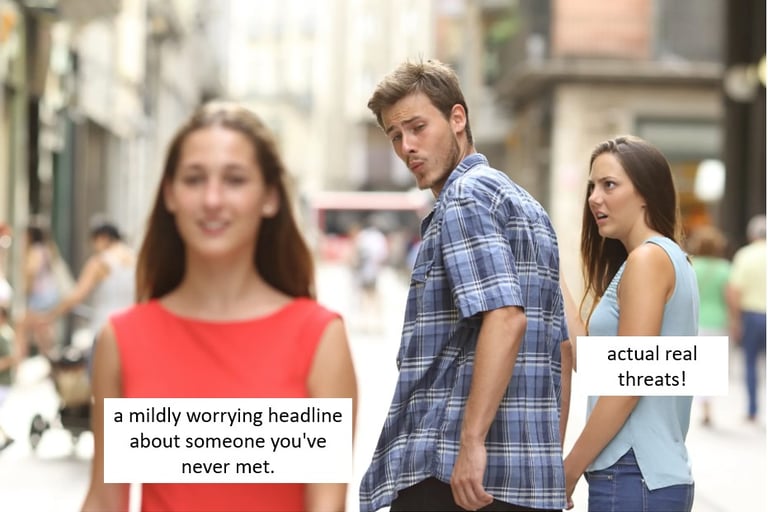
A lion chasing you. A passive-aggressive email from your boss. A weird twinge in your chest. Your mortgage renewal. A headline that says "Common Symptom You've Ignored Could Be Warning Sign."
To your ancient threat-detection system, these all register the same way, as danger. And it responds the same way every time: full emergency protocol, no questions asked.
This is why anxiety feels so physical. The racing heart, the tight chest, the churning stomach, the dizziness, the tingling hands. These aren't imaginary. They are completely real physiological responses to a very real biological system doing its job. The only problem is that the job it's doing is preparing you to outrun a predator that isn't there.
Why It Gets Worse in This Age
I can't claim to know what was going through our ancestors' minds. I've never lived on the African savannah or spent a night in a cave. But science tells us that humans sought shelter since ancient times. During the day they hunted and foraged, but then they withdrew to their caves for the night, presumably playing some prehistoric version of bingo and drinking whatever passed for hot wine back then. You need to wind down after a hard day in the savannah, after all.
The point is that the survival instinct that fired during the day had a chance to subside at night. Their worries were real but contained. Don't get eaten while you're out, find food tomorrow. That rising and falling rhythm of anxiety was manageable, because the threats were finite and then they stopped.
Even a farmer in Utah at the start of the 20th century had a limited anxiety diet. The most alarming news he might receive was that his neighbour had bought a new tractor. Once in a blue moon. That was it.
Why It Gets Stuck On
So the environment isn't helping. But even accounting for that, some people's systems get stuck in a way that goes beyond just having too many notifications. For these people, particularly those prone to health anxiety, the fight-or-flight response doesn't just fire more often. It stops switching off altogether.
Part of this is habit. Your nervous system learns patterns. If you've spent months scanning your body for symptoms, your brain starts treating the scanning itself as evidence that there's something to find. The anxiety feeds the vigilance, the vigilance feeds the anxiety, and before long you're lying awake at 2 AM with a heart that's doing something it definitely wasn't doing an hour ago.
Part of it is also sensitivity. Some people's amygdalas are simply more reactive than others, more trigger-happy, more prone to false alarms. This isn't weakness. It's wiring. And wiring, unlike character, can be worked with.
The Slightly Reassuring Bit
Here's what all of this means in practice: if you have anxiety, your brain is not broken. It is not sick. It is not a sign that something is fundamentally wrong with you. It is an ancient system running a very old programme in a world it wasn't built for.
The physical symptoms you feel are real, but they are the symptoms of anxiety, not of the seventeen conditions you've been reading about at midnight. A racing heart caused by adrenaline is not the same as a racing heart caused by a cardiac event, even though they feel identical from the inside. Your body knows the difference, even when your brain doesn't.
Anxiety is not dangerous. It is not progressive. It cannot hurt you, even when it feels like it absolutely can. On the contrary, it's trying to protect you.
It is, however, extremely persuasive. And that is something worth understanding, because the moment you stop believing every alarm your brain sounds, the alarm starts to sound a little less often.
Your ancient bodyguard is just doing his job. He needs a bit of retraining, not a resignation letter.
Image credits: "This is Fine" panel © KC Green, originally published in Gunshow webcomic (2013), used here for commentary purposes. Hercules (2014) still © Paramount Pictures/Metro-Goldwyn-Mayer, used here for commentary purposes. The IT Crowd © Channel 4/Talkback Thames, used here for commentary purposes. Distracted Boyfriend original photograph © Antonio Guillem/Shutterstock, annotations added for illustrative and commentary purposes.
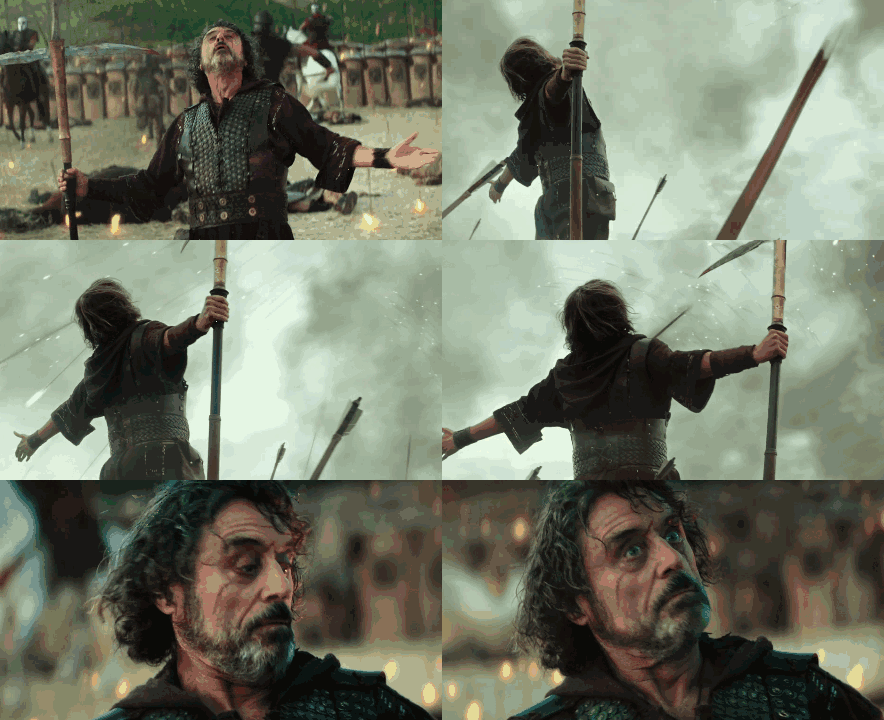
Statistically speaking, you are almost certainly not this man's kin.
Spoiler Alert! You can't switch of amygdala.
The relaxed ones who thought "eh, probably nothing" became someone's lunch. They were, by all accounts, lovely people. Calm, rational, excellent at putting things in perspective. They just didn't pass on many genes.
Anyway, back to the savannah! The humans who were slightly paranoid, who heard a rustle and immediately assumed the worst, were the ones who ran first and got eaten last. They didn't stop to gather evidence. They didn't weigh up the probabilities. They felt the threat, their body responded, and they moved. Fast.
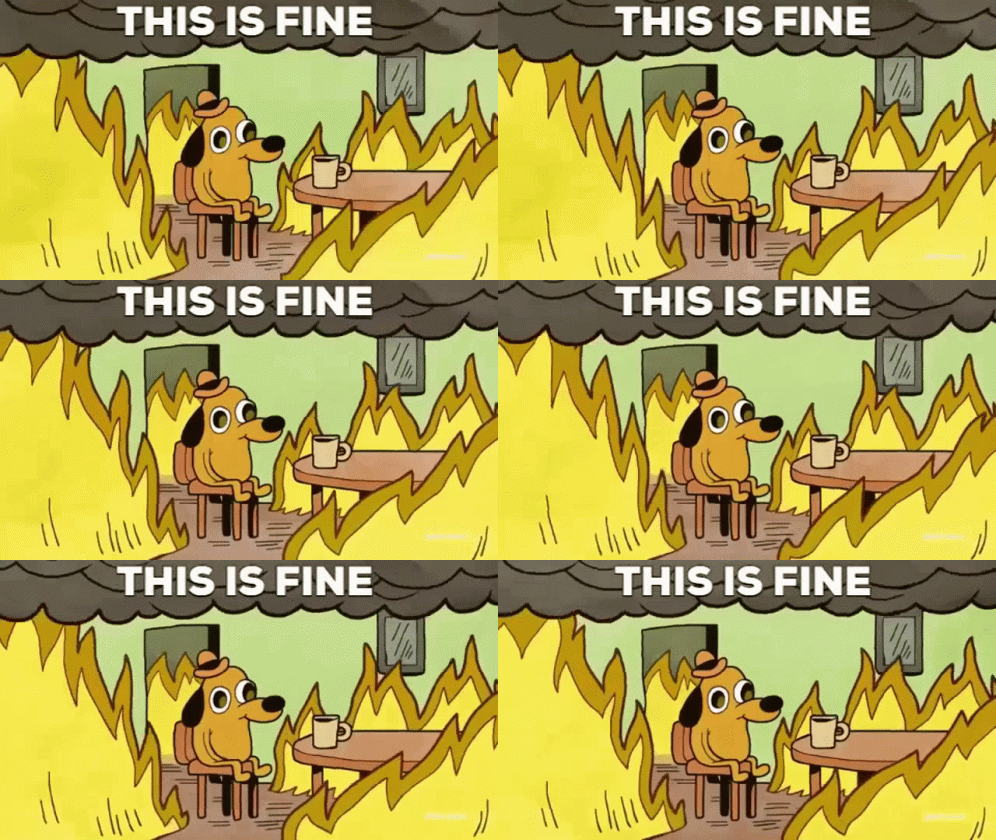
Those days are long gone. We now live in a world of instant, unlimited, global bad news delivered directly into our palms the moment we wake up. Is a new war coming? Which celebrity was just diagnosed with something terrible? Why are thousands being laid off? The moment you open your phone, you are being exposed to more distressing stimulation than that Utah farmer encountered in an entire year.
And here's the thing: every time your brain encounters a piece of bad news, consciously or not, it runs a quick threat assessment. Could this happen to me? How likely is this? It plays the scenario out. Multiply that by a hundred notifications a day, and what you get is a nervous system that never fully stands down. The alarm is always faintly ringing. We are chronically, structurally overstimulated, and our ancient threat-detection systems were simply never built for this.
Stay
Join the MyWeirdSymptoms community to stay in touch!
Subscribe to My newsletter
© 2025. All rights reserved.
Disclaimer
The content on My Weird Symptoms is for informational and entertainment purposes only. Nothing on this site is intended to be, or should be taken as, medical advice, diagnosis, or treatment. All opinions expressed here are the author's own and are based on personal experiences, research, and humour — not professional medical training.
Always seek the guidance of a qualified healthcare professional with any questions you may have regarding your health or a medical condition. Never disregard professional medical advice or delay seeking it because of something you've read here. If you think you may be experiencing a medical emergency, call your doctor or emergency services immediately.
Copyright & Fair Use
My Weird Symptoms occasionally uses images, graphics, or short clips from third-party media (such as TV shows, movies, and books) for purposes of commentary, criticism, humour, education, or parody. These materials remain the property of their respective copyright holders. We make no claim of ownership and do not intend to infringe on any copyrights.
Such use is intended to fall under fair use (17 U.S.C. § 107) as commentary, criticism, or parody. We use only small portions necessary to illustrate our commentary and always provide proper attribution where possible. If you are a copyright holder and believe any content should be removed, please contact us, and we will address it promptly.
Accuracy & Liability
While we strive for accuracy, information on this site may become outdated or contain errors. We make no guarantees about the completeness, reliability, or accuracy of information presented. Any action you take based on information from this site is strictly at your own risk.